
I went knocking doors in Reynoldston last week, and walking up through one of the oldest parts of the Village, I noticed a job that looked way better than any of the other installations I´d seen in the village. The visible part of the system -the way the panels were configured on the roof- had obviously been designed with far greater expertise and fitted with much greater care and skill than any of the other arrays I had come across. I noticed the modules looked an awful lot like the Sanyo HIT 250´s I have in my own house (these were a quantum leap ahead of anything else in their era). Fifteen years is a long time. The penny dropped: this was one of my earlier jobs (we’d probably done 20-30 at this point; fewer than 50, in any case). So I walked up to the door to see if my old customers were still living there and obviously to get their opinion on the system now that so much time has passed.
Turns out that they were both well, and both were home when I knocked the door. I asked them how the system was doing. I knew that it must have worked perfectly for the first 10 years because we never heard from them after the installation at any time within the garantee period. He told me that it been absolutely fantastic and had worked the whole time without any issues, made him a ton of money, and that he was particularly glad that he’d taken my advice regarding the inverter (I´ll discuss a few points about the panels we recommended below), opting for what was then a state of the art piece of kit made by a prestigious Austrian copmany, at a time when European manufactures were still considered the world leaders in these things, when all the other people who’d quoted him (12 in all), had proposed what was essentially the cheapest and nastiest kit available within the regulations), because after 15 years it was still working perfectly and well worth the extra investment above what the budget equipment.would have cost.
The panels he didn´t even need to mention – and this really is one of the most salient aspects of the story I wish to tell you: Back then, in 2011,, all households would have been aiming to get a 4kwp Solar PV installation, or as close to it as possible. This is because that was the maximum size allowed before the unit price paid for electricity generated by the system, dropped precipitously, effectively capping the size of the array, as a slightly bigger system would have resulted in lower returns. So the standard quote from your bog standard solar installer was for 16 X 250 panels in 2 rows of 8 in portrait. Most companies could not fit on slate roofs (which is much easier to do these days with advances in the roof-fixing technology), many couldn’t fit landscape, and most were abysmal at system design.
The customer was really haggling make hard on the price, and showed me all of the other quotes he’d received, as I had trouble believing some of them were so low (whilst others were exorbitantly high – nearly twice as much, for kit half as good). Anyway, when he showed me them it was immediately apparent why: They all used the cheapest of the cheap kit, and all were completely inept. Every single one of the designs was for 2 rows of 8 panes, in portrait. Im looking at the guy´s roof and thinking that, although its wide enough for that many rows, it isn’t high enough to accommodate those modules. You’re supposed to leave 30cm from the edges of the roof, because of wind-loading and water run-off (although with adequate mitigation measures, you can go nearer than this whilst staying within the regulations), but that wasn’t the issue here – these would have been stocking about a foot beyond the ridge tiles.
The budget panels every other firm quoted for were about 5% less efficient than the Sanyo modules I ended up recommending. I told the customer that, intuitively, I suspected that by using these modules in a different configuration, I would be able to deliver him his 4kwp, but that it was impossible any other way as they physically wouldn’t fit on his roof. Anyway, to find out -dont forget there was no solar design software incorporating satellite imagery and artificial intelligence back then, just SAP calculations, tape & laser measures, an old fashioned common sense!- I crawled through a tiny loft space (this is an approximately 200 year old house), in an Armani suit, to ascertain one and for all whether the design I was visualising would in fact work.
I climbed down out of the loft and dusted myself down. There was no way that two rows portrait with the less efficient panels fitted; in fact in portrait, neither would the Sanyo -which were about 10cm shorter and narrower than any other panels available). But fitted landscape, there was just about room to do two rows of six, and one of row of four above, with fitted in neatly between the chimneys at both ends, getting the customer to the maximum power allowed in the only possible way, whilst avoiding shading from the chimneys as much as as possible, and crucially, maintaining the balanced, symmetrical look of the beautiful, traditional old cottage within the conservation area.
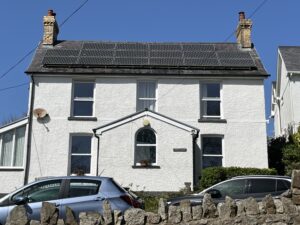
Needless to say, when we competed the work for him, he was absolutely chuffed. I remembered asking him at the time how he´d have felt if he’d gone with one of the many cowboys who’d come out to see him, and it turned out, a few hours into the job, that they were only able to install half as many panels for him as he’d ordered, or if contrary to all the regulations, they’d fitted them all anyway and they stood out about a foot beyond the roof-line. I cant remember his response from all that time ago, but it was obviously only meant rhetorically in any case.
So what are the take-aways here? Well, we always say you should buy from Ecotekk, not because we’ll do you the best deal (all things considered, we definitely will), or because we offer the best value, when considering, design, kit used, quality of workmanship, levels of guarantees and aftercare, etc, which will all be true also. But because we know our stuff better than everyone else, and we really care. Getting your job perfect is all that matters to us here.
By now there must be 50 solar Pv installations in Reynoldton. There’s a few utterly terrible looking designs, and quite a few very ordinary looking ones that might not have any blatantly obvious design flaws, but which are entirely lacking any kind of wow factor. And then you see this one of our from way back – just a stunning example of what an intelligently designed and skilfully installed system is capable of looking like, and by a million wonky light years the most visually appealing job in the village -a work of art in solar PV.
Ive been promising a blog pst on why system design is probably the most important aspect of the entire project soar project. That is coming soon. But this real example from a long time ago was really worth sharing because its so immediately clear why it matters and why Ecotekk are just better than everyone else at it.